|
Depending upon the rate structure
of your electric utility, you may be able to save a substantial
amount of money on your electric bill. Pay-back period for
an equipment purchase including installation cost may be less
than six months to a year. Utility rate structures that account
for reactive power consumption, by either a KVA or var demand
usage, or a power factor penalty are the ones that can provide
this pay-back. Other ancillary benefits to be gained by correcting
power factor are, lower energy losses, better voltage regulation
and released system capacity. This page explains the fundamentals
of power factor and how NEPSI's shunt capacitor banks can
benefit you.
All electric equipment requires
"vars" - a term used by electric power engineers
to describe the reactive or magnetizing power required by
the inductive characteristics of electrical equipment. These
inductive characteristics are more pronounced in motors and
transformers, and therefore, can be quite significant in industrial
facilities. The flow of vars, or reactive power, through a
watt-hour meter will not effect the meter reading, but the
flow of vars through the power system will result in energy
losses on both the utility and the industrial facility. Some
utilities charge for these vars in the form of a penalty,
or KVA demand charge, to justify the cost for lost energy
and the additional conductor and transformer capacity required
to carry the vars. In addition to energy losses, var flow
can also cause excessive voltage drop, which may have to be
corrected by either the application of shunt capacitors, or
other more expensive equipment, such as load-tap changing
transformers, synchronous motors, and synchronous condensers.

Figure 1 - Power Factor Triangle
The power triangle shown
in figure 1, is the simplest way to understand the effects
of reactive power. The figure illustrates the relationship
of active (real) and reactive (imaginary or magnetizing) power.
The active power (represented by the horizontal leg) is the
actual power, or watts that produces real work. This component,
is the energy transfer component, which represents fuel burned
at the power plant. The reactive power, or magnetizing power,
(represented by the vertical leg of the upper or lower triangle)
is the power required to produce the magnetic fields to enable
the real work to be done. Without magnetizing power, transformers,
conductors, motors, and even resistors and capacitors would
not be able to operate. Reactive power is normally supplied
by generators, capacitors and synchronous motors. The longest
leg of the triangle (on the upper or lower triangle), labeled
total power, represents the vector sum of the reactive power
and real power components. Mathematically, this is equal to:

Electric power engineers
often call total power, kVA, MVA, apparent power, or complex
power. Some utilities measure this total power, (usually averaged
over a 15 minute load period) and charge a monthly fee or
tariff for the highest fifteen minute average load reading
in the month. This tariff is usually added to the energy charge
or kilowatt-hour charge. This type of billing is often called
kva demand billing and can be quite
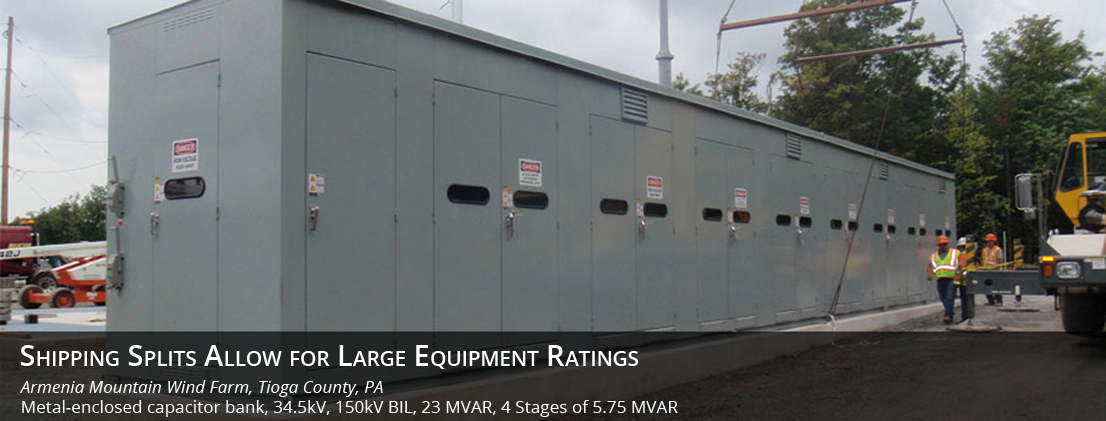
costly to an industrial facility. NEPSI's shunt capacitors
can save your company money by decreasing your reactive power
component supplied by the utility to near zero vars.
The power triangle and the
equation above show, that as the reactive power component
is decreased by adding shunt capacitors, the total power will
also decrease. This is shown by the decreased length of the
dashed lines in the power triangle as the reactive power component
approaches zero. Therefore, adding capacitors, which will
supply reactive power locally, can reduce your total power
and monthly kva demand charge.
The angle "phi" in
the power triangle is called the power factor angle and is
mathematically equal to:

The ratio of the real power
to the total power in the equation above (or the cos of phi)
is called power factor. As the angle gets larger (caused by
increasing reactive power) the power factor gets smaller.
In fact, the power factor can vary from 0 to 1, and can be
either inductive (lagging) or capacitive (leading). Capacitive
loads are drawn down, and inductive loads are drawn up on
the power triangle. Most industrials normally operate on the
upper triangle (inductive or lagging triangle). As an industrial
adds capacitors, the length of reactive (inductive) power
leg is shortened by the number of capacitive kvar that were
added. If the number of capacitive kvar added exceeds the
industrials inductive kvar load, operation occurs on the lower
triangle. This is commonly referred to as over compensation.
Utilities charge for reactive
power in a countless number of ways. Some utilities charge
for kvar demand, while others charge a strait fee for a power
factor less than their target. To fully understand the benefits
of NEPSI's shunt capacitor and harmonic filters, you must
acquire your electric billing rate structure. This rate structure
will describe how cost for poor power factor are added to
your monthly bills. If you need assistance in calculating
your pay-back periods, feel free to contact our nearest factory
trained sales representatives or just call Northeast Power
Systems, Inc.
Table 1, which contains kilowatt
multipliers, can be used to calculate the amount of kvar required
to raise your "original power factor" to your "desired
power factor". For example, a facility has a peak kilowatt
demand of 5000 kW with a power factor of 0.80. The facilities
engineer wants to raise its power factor from 0.80 to 0.95.
The kW multiplier obtained from table 1 is 0.421. Multiplying
this value times the facilities kilowatt demand yields 2105
kvar (0.421 X 5000 = 2105). Therefore, a 2105 kvar capacitor
bank would raise the facility's power factor from 0.80 to
0.95.
Table - 1 Kilowatt
Multipliers

In addition to the above
table, the following web page can be used to calculate the
required amount of vars based upon an initial power, desired
power factor, and kw demand (Calculation
of Required kvar to Raise Power Factor).
Other equations and calculation
methods for power factor correction exists in the formula
section of this website.
Northeast
Power Systems, Inc.
66 Carey Road
Queensbury, New York 12804
Phone: 518-792-4776
Fax: 518-792-5767
E-mail:
sales@nepsi.com
Website
: www.nepsi.com
|